
There’s a strange moment in many small businesses.
You hire your first one or two people because you’re “too busy.” Work is coming in, you’re maxed out, and adding people feels like the obvious way to grow.
Then a few months later, you notice:
- You’re still working late
- Clients still come to you for everything
- Your team keeps asking, “What should I do next?”
You added people, but you didn’t really add capacity. In some ways, it feels heavier than before.
The problem isn’t your team. It’s that you tried to scale a business that lives in your head.
In 2026, the businesses that successfully grow from one person to a small, effective team won’t be the ones that simply hire more hands. They’ll be the ones that build AI‑ready systems around how work gets done—so new people plug into a structure instead of into chaos.
Why Early Hiring Often Feels Like “More Work, Not Less”
Most owners secretly hope that hiring will instantly free them:
“I’ll finally have time to think.”
In reality, the first hires often create new problems:
- Work is delegated, but decisions still bounce back to you
- New people do things “their way,” and quality becomes inconsistent
- You become manager, trainer, and firefighter on top of everything else
This happens because your business is running on personal memory and ad‑hoc decisions, not on visible systems.
To grow from solo to a small team without losing your sanity, you need to shift from “I do everything” to “this is how we do things here”—and then let AI help you build and maintain that “how.”
Step 1: Redefine Your Own Role Before You Add More
Scaling starts with a hard look at your own job.
List everything you currently do in a typical week. Then group your work into three buckets:
- CEO work: decisions, strategy, relationships, design of systems
- Expert work: high‑skill tasks clients pay a premium for
- Operator work: admin, coordination, repetitive execution
Your growth goal is simple:
Gradually pull yourself out of operator work, then out of most expert work, so you can spend more time as CEO of a system, not worker in a mess.
AI can help you categorize and prioritize:
- Feed it your task list and ask it to sort tasks into those three buckets
- Ask which tasks are easiest to systemize or delegate first
- Have it suggest what your ideal weekly schedule might look like at the next stage of growth
Now you know what you should be stepping away from—and what kind of help you actually need.
Step 2: Define “Jobs to Be Done,” Not Just Job Titles
Too many small businesses hire based on vague labels:
- “Operations person”
- “Assistant”
- “Manager”
Instead, define jobs to be done—clear sets of responsibilities and outcomes.
For each role you’re considering, answer:
- What recurring tasks will this person own completely?
- What decisions will they be allowed to make alone?
- How will we know they’re doing a good job in 3–6 months?
Turn this into a simple role snapshot:
- Purpose: Why this role exists
- Key responsibilities: 5–7 things they own
- Key metrics: 3–5 measurable indicators of success
AI can translate your messy thoughts into a clean role description and “scorecard” you can share with candidates and team members.
Step 3: Systemize the Work Before You Fully Delegate It
The biggest mistake with early hires is handing over tasks without handing over a system.
Before you give someone full ownership of an area like onboarding, scheduling, support, or reporting, capture:
- The basic workflow (steps from start to finish)
- The key tools and where information lives
- Any critical rules or thresholds (“if X happens, escalate”)
Use AI to go from rough to structured:
- Record yourself explaining how you currently do a process.
- Transcribe it or turn it into bullets.
- Ask AI to turn that into:
- A clear SOP (Standard Operating Procedure)
- A shorter checklist for daily use
- Draft templates (emails, messages, docs) used in that process
Now you’re not just saying, “Handle onboarding.” You’re saying, “Here’s how we onboard. You own this system.”
Step 4: Build a Simple, AI‑Supported Onboarding Path for New Team Members
Hiring someone is the easy part. Turning them into a confident, autonomous team member is where most businesses stumble.
Design a basic onboarding path that covers:
- Week 1: Orientation
- Company overview, tools, access, key policies
- Walkthrough of their role snapshot and main workflows
- Weeks 2–3: Guided execution
- They execute tasks with you or another team member watching
- They use SOPs and checklists every time
- Weeks 4–6: Supported independence
- They own tasks, but you review samples and edge cases
- Feedback goes into improving the SOPs, not just their memory
AI can help by:
- Generating a structured onboarding schedule from your notes
- Creating short quizzes or checklists to confirm understanding
- Summarizing early performance and questions into clear improvement points
Instead of onboarding being chaotic and improvised, it becomes a repeatable mini‑system you can reuse for every new hire.
Step 5: Add Lightweight Rhythms for Communication and Accountability
As you grow from 1 to 3–5 people, communication can either become constant noise—or a quiet rhythm that keeps everyone aligned.
Introduce a few simple cadences:
- Weekly team check‑in (30–45 minutes)
- What’s the focus this week?
- What’s blocked?
- What did we learn last week?
- Short 1:1s every 1–2 weeks
- For support, feedback, and development—not micro‑management
- Shared dashboard or summary
- Visible metrics and key work in progress
AI can act as your meeting assistant:
- Summarizing last week’s work and numbers before the meeting
- Turning rough notes into clear action lists and decisions
- Highlighting recurring issues across multiple weeks
Now you lead with information, not intuition alone.
Step 6: Connect Your Growing Team to a Real Systems Backbone
By this point, you’ve got:
- Defined roles and responsibilities
- Basic SOPs and checklists for key processes
- Onboarding paths and simple team rhythms
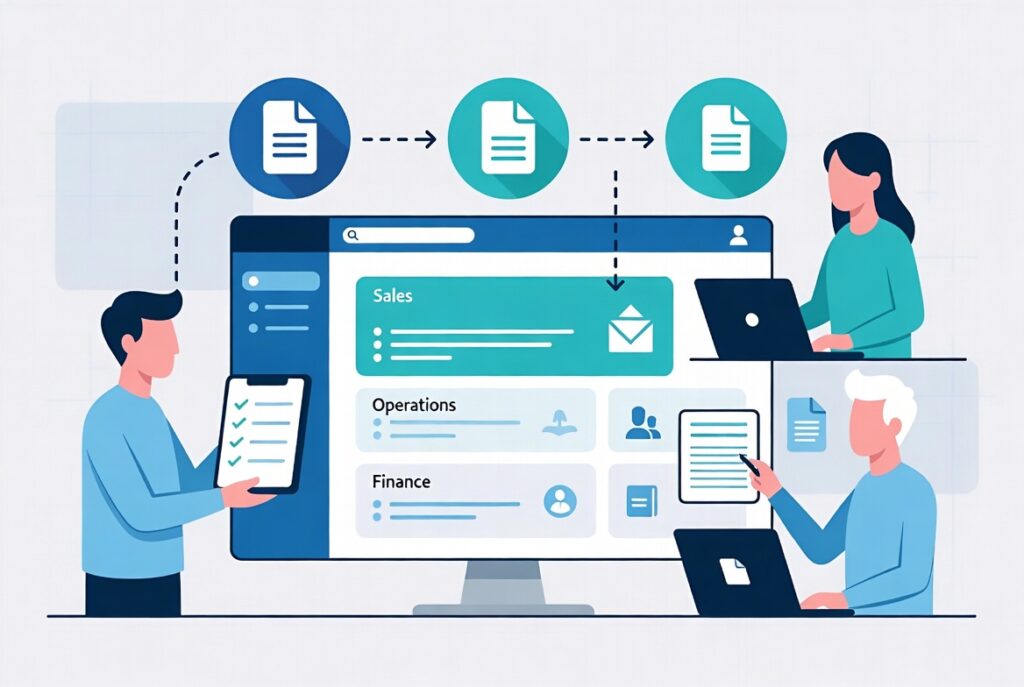
To truly scale, you need to connect it all into a coherent systems backbone:
- A central place where processes, templates, and docs live (your internal wiki)
- Dashboards that show what’s happening across sales, delivery, and operations
- AI prompts and workflows that your whole team can use—not just you
This is where many owners hit their limit trying to “DIY” systems design with random tools and articles. It’s also where a focused toolkit can turn years of trial and error into weeks of structured progress.
How AI‑Ready Business Systems Toolkit 2025 Helps You Scale From Solo to Small Team
The AI‑Ready Business Systems Toolkit 2025 from Analytics Need is built for exactly this stage: when you’re ready to grow beyond yourself, but you don’t want to lose control—or spend all your time managing people instead of improving the business.
Here’s how the toolkit supports your journey from one person to a small, effective team:
- Role and work mapping frameworks
- Guided exercises to break your current workload into CEO, expert, and operator work
- Templates to turn those insights into clear role snapshots and scorecards
- Process and SOP design tools
- Visual and written templates to document key workflows (sales, onboarding, delivery, support)
- AI prompts to convert your rough explanations into structured SOPs and checklists
- Onboarding and training blueprints
- Pre‑designed onboarding journeys for new hires in operations, client service, and admin
- AI‑assisted content generation for guides, FAQs, and micro‑training materials
- Team rhythms and dashboards
- Meeting templates for weekly check‑ins and 1:1s, linked to key metrics
- Dashboard layouts and AI prompts that turn data into short, readable team updates
- Integration with your wider systems
- Guides for connecting team roles to your internal knowledge base, lead systems, and support flows
- Examples of how small teams use the toolkit to manage capacity and growth without burning out
Instead of hiring first and hoping the structure will appear, you design the structure with AI doing much of the writing, summarizing, and formatting—then plug people into a system that’s ready for them.
If you want 2026 to be the year you stop being “the business” and start leading a small, capable team, the AI‑Ready Business Systems Toolkit 2025 gives you a practical way to build that transition on purpose: step by step, system by system, with AI as your quiet partner in the background.